


Ransomware Protection & Recovery Planning Kerala
A ransomware attack can do more than encrypt files. It can interrupt billing, stop access to customer records, delay operations, and leave employees unable to use essential systems. For businesses in Kerala, the challenge is not only preventing an attack but also knowing how to recover when critical systems become unavailable.
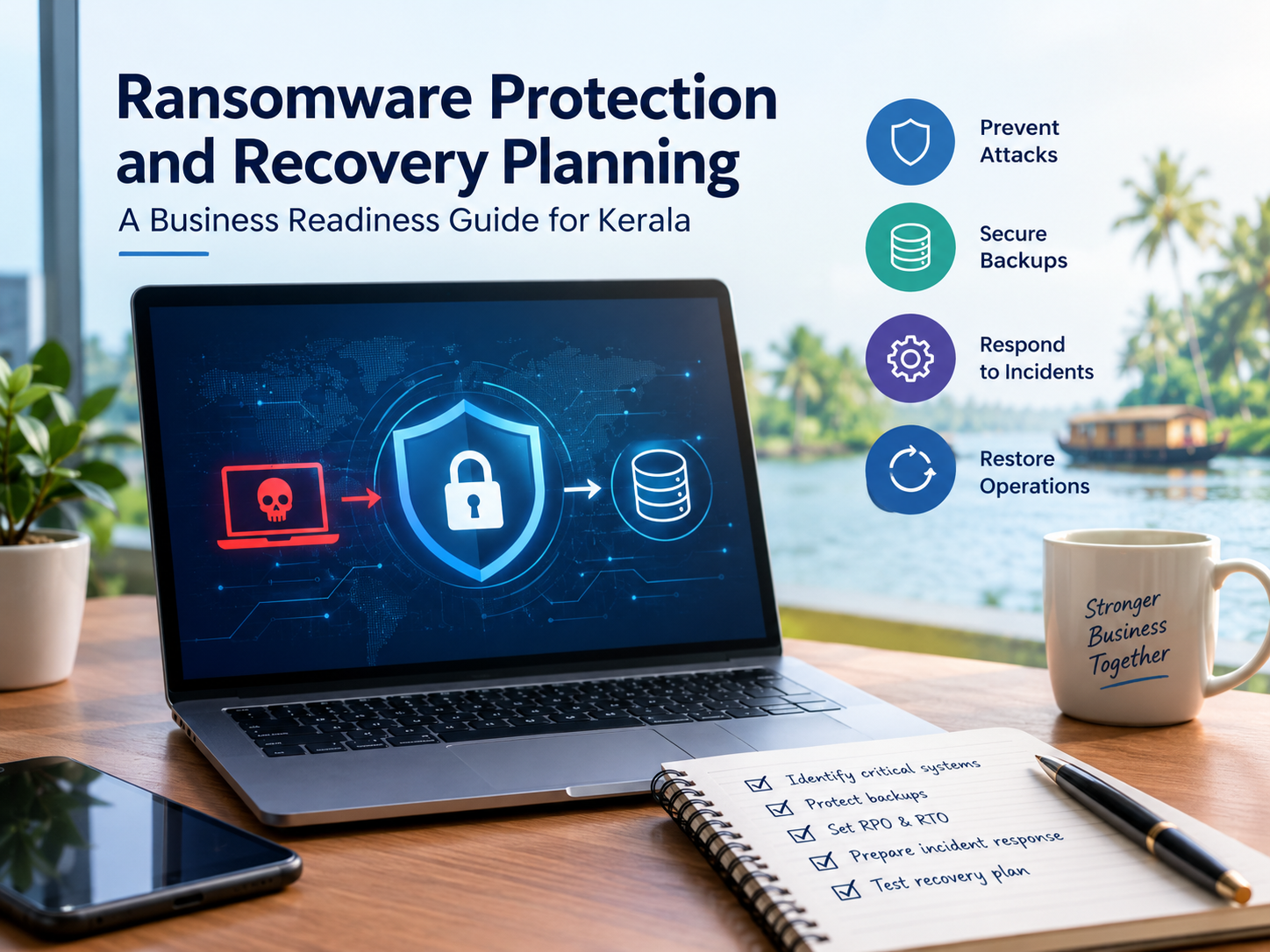
Ransomware protection and recovery planning brings these two priorities together. It combines security controls, reliable backups, incident response procedures, and a tested plan for restoring business operations.
A recovery plan is not simply a document. It is a practical process that helps an organization identify what matters most, protect its recovery resources, and restore systems in a controlled way.
What Is Ransomware Protection and Recovery Planning?
Ransomware protection focuses on reducing the likelihood and impact of an attack through measures such as endpoint security, access controls, patching, network monitoring, and employee awareness.
Recovery planning focuses on what happens if those controls fail. It defines:
- Which systems and data must be restored first
- How backups will be protected and accessed
- Who is responsible for decisions during an incident
- How long critical services can remain unavailable
- How systems will be restored and verified safely
Why Businesses in Kerala Need a Ransomware Recovery Plan
Ransomware can affect organizations of different sizes and industries. A small business may depend on a single server, accounting application, or shared storage system, while a larger organization may have multiple locations, cloud platforms, and interconnected services.
An attack can create several challenges:
- Operational disruption: Employees may lose access to applications and files.
- Financial impact: Downtime can delay sales, payments, and service delivery.
- Data exposure: Attackers may steal information before encrypting systems.
- Recovery uncertainty: Backups may exist but may not be usable or sufficiently isolated.
- Reputational damage: Customers and partners may lose confidence if services are interrupted.
1. Identify Critical Business Systems
Before choosing a backup schedule, businesses should understand what they actually need to recover.
Create an inventory of:
- Servers and network devices
- Business applications and databases
- Customer and financial data
- Cloud services and SaaS accounts
- Employee devices and shared storage
- Dependencies such as DNS, authentication, and network access
2. Protect Backups from Ransomware
Having a backup does not automatically mean having a recoverable backup. If attackers can access, delete, or encrypt the backup environment, recovery may become difficult.
A ransomware-resilient backup strategy should consider:
- Offline or isolated copies of critical data
- Encryption for stored and transferred backups
- Separate administrative access for backup systems
- Immutable or protected storage, where appropriate
- Multiple recovery copies across suitable storage locations
- Regular backup verification and restoration testing
3. Define RPO and RTO
Two important recovery planning concepts are Recovery Point Objective (RPO) and Recovery Time Objective (RTO).
- RPO: How much recent data the business can afford to lose.
- RTO: How long a critical system can remain unavailable before restoration is required.
4. Prepare an Incident Response Process
When ransomware is suspected, employees should know what to do and what not to do.
A basic response plan should include:
- Identify and report suspicious activity quickly.
- Isolate affected systems where appropriate to limit spread.
- Protect evidence and logs for investigation.
- Assess the scope of the incident.
- Notify relevant internal decision-makers and external specialists.
- Prioritize recovery using the predefined critical-system list.
- Restore from trusted backups and verify systems before reconnecting them.
5. Test the Recovery Plan
A recovery plan that has never been tested may contain hidden problems.
Businesses should periodically verify:
- Can backup data actually be restored?
- Are recovery credentials available and protected?
- Can critical applications operate after restoration?
- Are dependencies documented?
- Can systems be rebuilt if the original infrastructure is unavailable?
- Do employees know their responsibilities during an incident?
How GKS Infotech Can Support Ransomware Readiness
GKS Infotech can help businesses assess their IT environment, identify recovery requirements, and develop practical protection and recovery strategies. Depending on the organization’s needs, this may include cybersecurity consulting, network security, backup and recovery planning, IT infrastructure management, and business continuity support.
The right approach depends on the systems, data, recovery objectives, and operational requirements of each business. A professional assessment can help identify which safeguards and recovery measures are appropriate.
Conclusion
Ransomware readiness is not only about installing security software. It is about ensuring that a business can protect critical data, respond to an incident, and restore essential operations.
For businesses in Kerala, a practical ransomware recovery plan should include critical-system identification, protected backups, defined RPO and RTO targets, incident response procedures, and regular recovery testing.
The most useful time to test a recovery plan is before the business needs it.
Frequently Asked Questions
What is ransomware recovery planning?
Ransomware recovery planning is the process of preparing how a business will restore critical systems and data after a ransomware incident. It includes backup protection, recovery priorities, response procedures, and restoration testing.
Are regular backups enough to protect against ransomware?
Not always. Backups may also be targeted if they are accessible from compromised systems. Businesses should consider isolated or offline copies, appropriate access controls, encryption, and regular restoration testing.
How can Kerala businesses prepare for ransomware recovery?
They can begin by identifying critical systems, reviewing backup arrangements, defining recovery objectives, preparing an incident response plan, and testing whether essential services can be restored safely.
Does GKS Infotech provide ransomware protection and recovery planning?
GKS Infotech can support businesses with cybersecurity, IT infrastructure, and recovery-planning requirements. The specific services and implementation approach should be confirmed through an assessment of the organization’s environment.