


Cybersecurity Risk Assessment Checklist for Businesses: How to Identify Security Gaps
Cyber threats are no longer occasional business risks. They are continuous, evolving challenges that affect organizations of every size. From ransomware and phishing attacks to insider threats, weak passwords, cloud misconfigurations, and outdated systems, modern businesses face security pressures that can disrupt operations, expose sensitive data, and damage customer trust.
A cybersecurity risk assessment helps businesses identify security gaps before attackers exploit them. Instead of waiting for a cyber incident to happen, organizations can proactively review their IT environment, prioritize risks, strengthen defenses, and improve long-term business resilience.
Why Cybersecurity Risk Assessments Are Important for Businesses
Many businesses think cyberattacks only happen to companies.. That's not true. Medium-sized businesses, hospitals, banks, schools, factories and law firms are also targeted.
These smaller organizations are often more at risk. They may not have IT staff their systems might be old or they may not have strong controls in place. They might also not be monitoring their security properly.
A cybersecurity risk assessment helps businesses in ways:
- It finds security gaps that might not be obvious
- It reduces the risk of ransomware and phishing attacks
- It improves security for cloud and network systems
- It helps businesses be ready for audits and comply with regulations
- It reduces downtime and disruptions to operations
- It helps businesses plan better for incidents
Preventing cyberattacks is usually much cheaper than fixing the damage. Regular risk assessments help businesses make decisions, about security before anything bad happens.
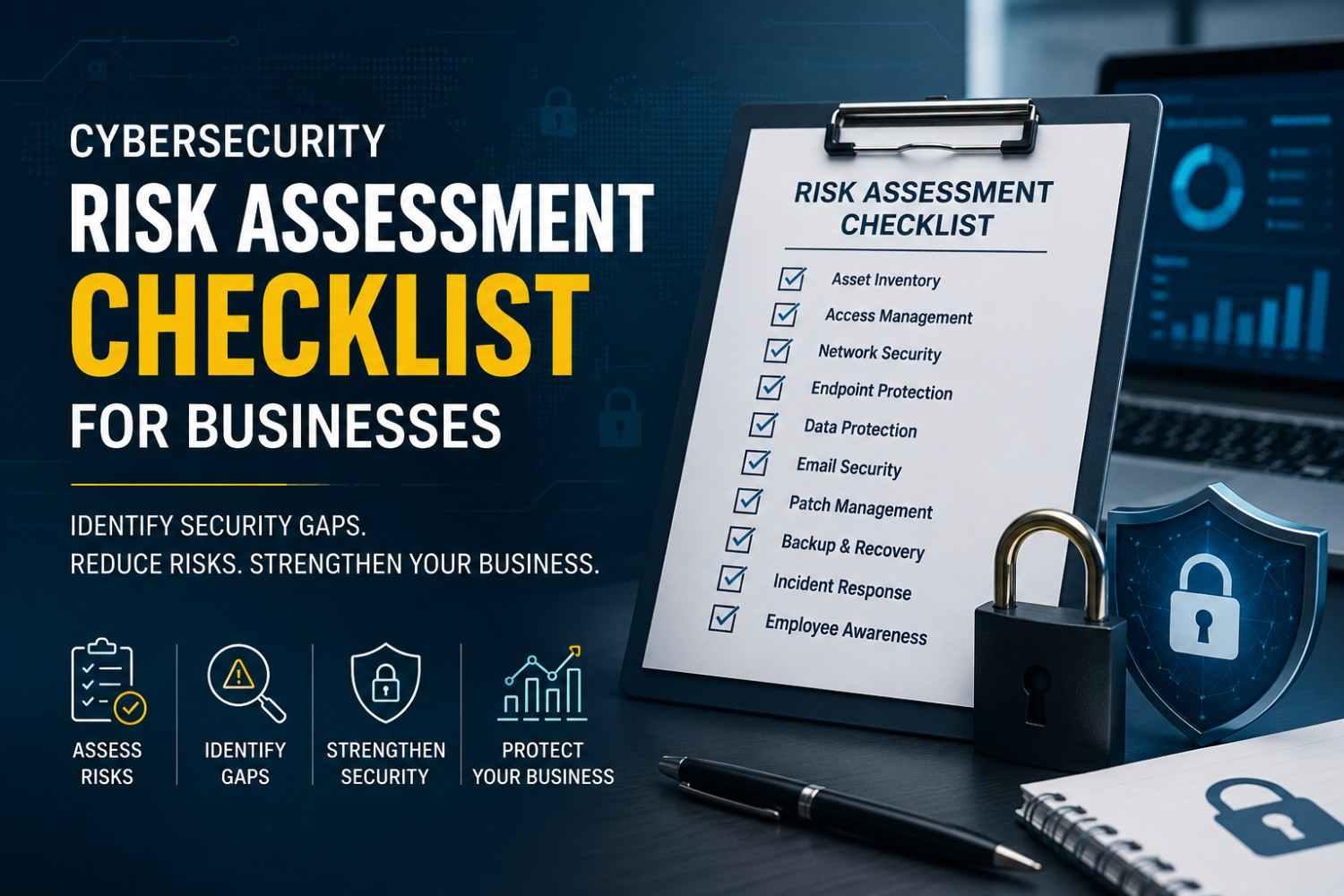
Cybersecurity Risk Assessment Checklist for Businesses
Below is a practical checklist businesses can use to evaluate their cybersecurity readiness.
1. Digital Asset Inventory
Every cybersecurity strategy begins with visibility. If a business does not know what systems, devices, applications, and data it has, it cannot protect them effectively.
Your organization should maintain an updated inventory of:
- Servers
- Databases
- Employee laptops and desktops
- Mobile devices
- Cloud platforms
- Business applications
- Network devices
- Firewalls and routers
- IoT and connected devices
- Critical business data
Asset inventory helps businesses understand what needs protection, where sensitive information is stored, and which systems are most critical for operations.
2. Identity and Access Management
Unauthorized access is one of the most common causes of security incidents. Weak passwords, inactive accounts, excessive privileges, and missing multi-factor authentication can create serious security risks.
Businesses should check whether they have:
- Multi-Factor Authentication enabled
- Role-based access control
- Regular user access reviews
- Strong password policies
- Secure administrator accounts
- Removal of inactive users
- Limited access for third-party vendors
- Proper onboarding and offboarding processes
3. Network Security Controls
A business network is one of the most important parts of its digital infrastructure. It connects users, devices, applications, servers, and cloud platforms. If the network is poorly protected, attackers may gain access to critical systems.
Key network security checks include:
- Firewall configuration review
- Secure VPN access for remote users
- Network segmentation
- Intrusion Detection or Prevention Systems
- DNS filtering
- Traffic monitoring
- Secure Wi-Fi configuration
- Regular review of network access rules
- Restricted remote access ports
Regular audits of firewall rules, remote access settings, and network traffic can help eliminate unnecessary exposure and reduce attack opportunities.
4. Endpoint Protection
Every device connected to the business network can become an entry point for attackers. Laptops, desktops, mobile devices, and servers must be properly secured and monitored.
Endpoint security should include:
- Endpoint Detection and Response
- Managed antivirus or anti-malware tools
- Device encryption
- Automatic patch updates
- USB and external device control
- Mobile device management
- Continuous endpoint monitoring
- Remote wipe capability for lost devices
Traditional antivirus tools alone are no longer enough for many modern threats. Advanced endpoint protection helps detect suspicious behavior, block malware, and respond quickly to potential attacks.
5. Backup and Disaster Recovery
Backups are one of the most important defenses against ransomware, accidental deletion, system failure, and data loss. However, backups are only useful if they are secure, updated, and tested.
Businesses should review:
- Multiple backup copies
- Offline or immutable backup storage
- Encrypted backup systems
- Regular backup schedules
- Restore testing
- Segregated backup credentials
- Disaster recovery documentation
- Recovery Time Objective and Recovery Point Objective
A backup that is not tested cannot be trusted during a real emergency. Regular restoration testing helps ensure that business data can be recovered when needed.
6. Cloud Security Review
Most businesses now use cloud platforms such as Microsoft 365, Google Workspace, AWS, Azure, or other SaaS applications. While cloud platforms are powerful, poor configuration can lead to data exposure and unauthorized access.
Cloud security checks should include:
- MFA for cloud accounts
- Identity and access management
- Secure file sharing policies
- Cloud activity logging
- Suspicious login monitoring
- Backup and recovery settings
- Admin account protection
- Data loss prevention settings
- Review of public file links
- Third-party app permissions
Cloud misconfigurations are one of the fastest-growing causes of data exposure. A regular cloud security review helps businesses reduce these risks.
7. Email Security Controls
Email remains one of the most common entry points for cyberattacks. Phishing emails, malicious attachments, fake invoices, credential theft attempts, and business email compromise attacks can target employees at every level.
Businesses should review:
- Spam and phishing filters
- Attachment scanning
- Email authentication protocols
- Domain protection
- Suspicious link detection
- User awareness training
- Reporting process for suspicious emails
- Protection against impersonation attacks
8. Employee Security Awareness
Human error continues to be a major cybersecurity risk factor. Employees may unknowingly click malicious links, reuse passwords, download unsafe files, or share sensitive information with unauthorized people.
Employees should be trained on:
- Identifying phishing emails
- Safe password practices
- Social engineering risks
- Secure data handling
- Reporting suspicious activity
- Safe internet usage
- Remote work security
- Handling customer or business data
9. Patch and Update Management
Outdated systems are among the easiest targets for attackers. Cybercriminals often exploit known vulnerabilities in operating systems, applications, firewalls, routers, plugins, and business software.
Organizations should ensure:
- Regular operating system updates
- Software patching
- Firmware updates for devices
- Firewall and router updates
- Cloud application updates
- Patch tracking and reporting
- Testing of critical patches before deployment
- Removal of unsupported software
10. Incident Response Preparedness
Even with strong security controls, cyber incidents can still happen. The speed and quality of response can determine how much damage occurs.
Businesses should have:
- Incident response plan
- Defined roles and responsibilities
- Escalation process
- Communication protocols
- Data recovery workflows
- Legal and compliance notification process
- Business continuity plan
- Cyber incident documentation process
- Regular tabletop exercises
Common Cybersecurity Gaps Found in Businesses
Many organizations unknowingly leave important security weaknesses unaddressed. During a cybersecurity risk assessment, common gaps often include:
- Weak or reused passwords
- Missing Multi-Factor Authentication
- Unsecured remote access
- Poor firewall configuration
- Outdated software and operating systems
- Unpatched network devices
- Poor cloud sharing settings
- Lack of employee training
- Untested backups
- Excessive user privileges
- Inactive accounts still enabled
- No incident response plan
- Limited monitoring of suspicious activity
Cybersecurity Risk Assessment vs VAPT: What Is the Difference?
A cybersecurity risk assessment and VAPT are related, but they are not the same.
A cybersecurity risk assessment evaluates business risks, security gaps, likelihood of threats, potential impact, policies, users, systems, and operational readiness.
VAPT, which stands for Vulnerability Assessment and Penetration Testing, focuses more deeply on identifying and validating technical vulnerabilities in systems, networks, and applications.
In simple terms:
- A cybersecurity risk assessment identifies overall business security risks.
- A vulnerability assessment finds technical weaknesses.
- Penetration testing tests whether those weaknesses can be exploited.
- VAPT provides technical validation of security flaws.
Many businesses need both. A cybersecurity risk assessment helps with security planning and prioritization, while VAPT helps confirm technical weaknesses that require immediate attention.
Cybersecurity Risk Assessment for Businesses in Kerala
As Kerala continues its digital transformation, businesses across banking, healthcare, education, manufacturing, IT, retail, and professional services are becoming more dependent on digital systems.
Organizations using cloud platforms, online payment systems, customer databases, remote work tools, and connected networks face growing cyber risks.
Businesses in Kerala often handle:
- Customer financial data
- Patient health records
- Employee information
- Cloud-based business applications
- Payment and billing systems
- Internal business documents
- Remote workforce access
- Branch office networks
When Should Businesses Perform a Cybersecurity Risk Assessment?
Cybersecurity risk assessment is not a one-time activity. It should be performed regularly because threats, technologies, users, and business systems keep changing.
Businesses should perform a risk assessment:
- At least once every year
- After major infrastructure changes
- During cloud migration
- Before compliance audits
- After a cyber incident
- When adding new applications
- When expanding to new branches
- After mergers, acquisitions, or major vendor changes
- When implementing remote or hybrid work systems
How GKS Infotech Can Help
GKS Infotech helps businesses identify security gaps, assess IT infrastructure risks, strengthen access controls, improve cloud security, and build practical cybersecurity roadmaps.
Our team supports businesses with:
- IT infrastructure assessment
- Cybersecurity risk assessment
- Network security review
- Cloud security review
- Backup and disaster recovery planning
- Security monitoring support
Whether your business operates in healthcare, banking, education, manufacturing, or SME sectors, a structured security assessment can help you reduce risks and improve long-term resilience.
Speak with GKS Infotech to assess your current IT environment and identify the security gaps that need immediate attention.
Conclusion
A cybersecurity risk assessment is a good way for businesses to find out where they are weak on security figure out which cyber risks are most important and make their security better before someone attacks them. By checking their computer systems, cloud storage, who has access to what network security and how they protect their data on a basis businesses can fix the weaknesses and be better prepared for cyber attacks in the long run.
Of waiting for a cyber attack to happen and then dealing with it businesses can use cybersecurity risk assessments to be prepared. This helps them follow the rules keep their assets safe and make sure their business keeps running smoothly. If needed these assessments can also include checking for vulnerabilities doing a VAPT and having a security audit to make sure everything is okay, from a point of view.
Whether your organization operates in healthcare, banking, manufacturing, education, IT services, or the SME sector, regular cybersecurity risk assessments are essential in today’s evolving threat landscape. Partnering with an experienced IT security provider like GKS Infotech helps businesses identify risks early, implement effective security controls, and build a secure, compliant, and future-ready digital environment.
FAQs
What is a cybersecurity risk assessment?
A cybersecurity risk assessment is a structured process used to identify, evaluate, and prioritize security risks across systems, networks, applications, users, and data. It helps businesses understand where security gaps exist and what actions should be taken first.
How often should a cybersecurity risk assessment be done?
A cybersecurity risk assessment should be done at least once a year. It should also be performed after major IT changes, cloud migration, security incidents, compliance audits, or the launch of new applications.
Is cybersecurity risk assessment useful for small businesses?
Yes. Small businesses are often targeted because they may have weaker security controls, limited monitoring, and fewer internal IT resources. A risk assessment helps SMEs identify practical security improvements based on their risk level.
What is the difference between vulnerability assessment and risk assessment?
A vulnerability assessment identifies technical weaknesses in systems, networks, or applications. A risk assessment evaluates the business impact, likelihood of threats, security gaps, and overall risk exposure.
Can a cybersecurity risk assessment prevent ransomware attacks?
A cybersecurity risk assessment cannot guarantee complete prevention, but it can reduce ransomware risk by identifying weak backups, unsecured remote access, poor patching, weak passwords, missing MFA, and endpoint security gaps.