


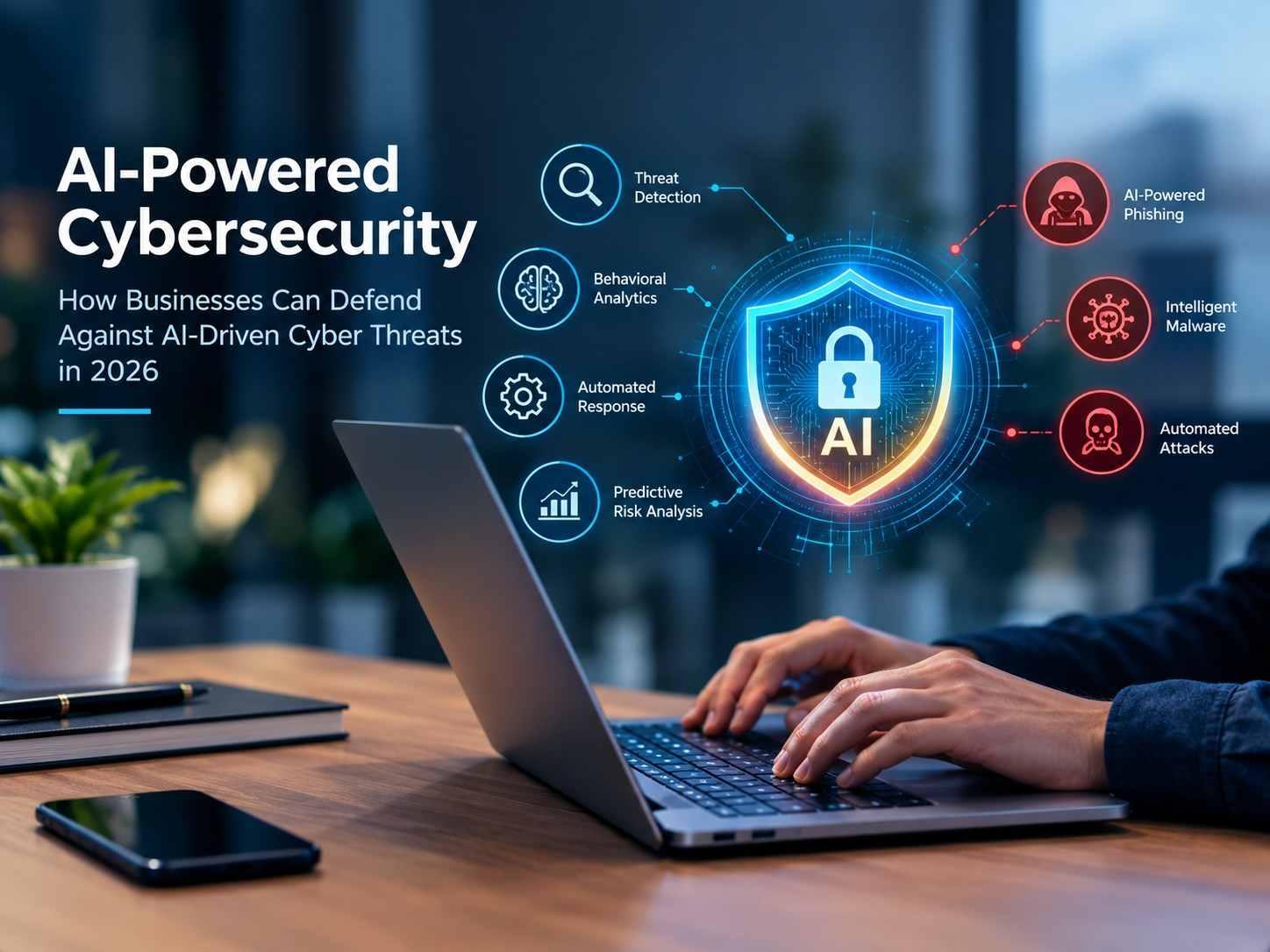
AI-Powered Cybersecurity: How Businesses Can Defend Against AI-Driven Cyber Threats in 2026
Artificial intelligence is transforming business operations, but cybercriminals are using the same technology to create faster and more sophisticated attacks. In 2026, businesses need cybersecurity strategies that can detect unusual behavior, respond quickly, and protect critical systems, data, and users.
AI cybersecurity combines artificial intelligence and machine learning with security tools to identify, analyze, prevent, and respond to cyber threats. Unlike traditional systems that depend heavily on predefined rules and known threat signatures, AI-powered security can analyze behavior and emerging attack patterns to help organizations detect suspicious activity earlier.
Why Is AI Cybersecurity Important in 2026?
AI is being used by attackers to automate phishing, generate malicious content, identify vulnerabilities, and improve social engineering campaigns. Businesses handling sensitive information including hospitals, banks, financial institutions, manufacturers, and enterprises face significant cybersecurity and operational risks.
Without proactive protection, organizations may experience:
- Data breaches and financial fraud
- Ransomware attacks
- Account compromise
- Regulatory and compliance issues
- Operational downtime
- Loss of customer trust
Common AI-Driven Cyber Threats
AI-Powered Phishing and Social Engineering
Attackers can create highly personalized messages that imitate legitimate communications. AI-generated voices and videos can also support deepfake-based impersonation of executives or employees.
Intelligent Malware
AI-assisted malware can adapt its behavior, making suspicious activity harder for traditional security tools to identify.
Automated Password and Vulnerability Attacks
Attackers can automate credential attacks and scan large numbers of systems for unpatched vulnerabilities, increasing the speed at which weaknesses are exploited.
Which Businesses Need AI Cybersecurity?
Healthcare
Hospitals and healthcare providers must protect electronic health records, medical devices, patient databases, hospital networks, and telemedicine platforms while maintaining service availability.
Banks and Financial Institutions
AI-powered threat detection can help identify suspicious transactions, account takeovers, insider threats, payment fraud, and identity-related attacks.
Manufacturing and Enterprises
Manufacturers and large enterprises increasingly depend on cloud platforms, IoT devices, ERP systems, remote access, and supply-chain networks. Cybersecurity must protect both digital infrastructure and critical business operations.
How Does AI Cybersecurity Protect Businesses?
Real-Time Threat Detection
AI continuously analyzes users, devices, applications, and network activity to identify suspicious behavior and potential threats.
Behavioral Analytics
AI can establish patterns of normal activity and flag anomalies such as unusual logins, unexpected file downloads, privilege escalation, or unfamiliar device access.
Automated Incident Response
Depending on the security platform and configuration, automated response can isolate compromised devices, block malicious connections, disable affected accounts, and alert security teams.
Predictive Risk Analysis
AI-assisted security tools can help organizations identify vulnerabilities and prioritize risks before attackers exploit them.
Best Practices for AI Cybersecurity
Businesses should combine AI-powered technologies with strong security processes and employee awareness. Key measures include:
- Zero Trust Security for continuous verification of users and devices
- Multi-Factor Authentication (MFA) to strengthen account protection
- 24/7 security monitoring and threat detection
- Cloud security with appropriate identity and access controls
- Endpoint and network protection
- Regular vulnerability assessments and VAPT
- Employee cybersecurity awareness training
- Reliable backup and disaster recovery planning
How Much Do AI Cybersecurity Services Cost?
Pricing depends on organization size, number of users and devices, cloud infrastructure, regulatory requirements, existing IT systems, and required monitoring. Small businesses may use managed cybersecurity services, while larger organizations may require advanced SOC monitoring, cloud security, endpoint protection, and compliance support.
Why Choose GKS Infotech for AI Cybersecurity?
GKS Infotech provides cybersecurity and managed IT solutions for businesses across India, Kerala, and Kochi. Its services include:
- Cyber Security Services
- Managed IT Services in Kerala
- Enterprise Cloud Services in Kochi
- Data Center Services in Kerala
- Vulnerability Assessment & Penetration Testing (VAPT)
- Cloud Security Solutions
- Endpoint and Network Security
- Security Monitoring
- Disaster Recovery Planning
Conclusion
As cybercriminals increasingly adopt AI, businesses must strengthen their cybersecurity strategies. AI-powered cybersecurity can improve threat detection, behavioral analysis, automated response, cloud protection, and overall risk management.
Whether protecting patient records, financial transactions, manufacturing systems, or enterprise infrastructure, organizations need proactive security that combines technology, skilled professionals, and strong security practices.
Contact GKS Infotech to explore Cyber Security Services, Enterprise Cloud Services in Kochi, Managed IT Services in Kerala, and Data Center Services in Kerala.
FAQs
Is AI cybersecurity safe for businesses?
Yes. AI can strengthen threat detection and automate security responses when implemented with appropriate human oversight, governance, and security controls.
How much do AI cybersecurity services cost?
Costs vary based on infrastructure size, users, monitoring requirements, security services, and compliance needs.
How quickly can AI detect cyber threats?
Detection speed depends on the security platform, threat type, data visibility, and configuration. AI-powered systems can identify suspicious behavior much faster than manual analysis in many scenarios.
Is AI security better than traditional cybersecurity?
AI complements traditional cybersecurity by improving behavioral analysis, anomaly detection, threat identification, and response automation. A layered security strategy remains essential.
How do I choose an AI cybersecurity provider?
Look for proven cybersecurity expertise, continuous monitoring, managed security capabilities, cloud experience, VAPT services, compliance knowledge, and the ability to tailor solutions to your infrastructure.