


Zero Trust Network Security Explained: Why Kerala Businesses Should Adopt It in 2026
Cyber threats are becoming more sophisticated as businesses adopt cloud platforms, remote work, mobile devices, SaaS applications, and digital services. Traditional perimeter-based security alone is no longer sufficient to protect modern IT environments.
For businesses seeking reliable IT Network Management Services in Kerala, Zero Trust Network Security provides a proactive approach to protecting users, devices, applications, and sensitive data.
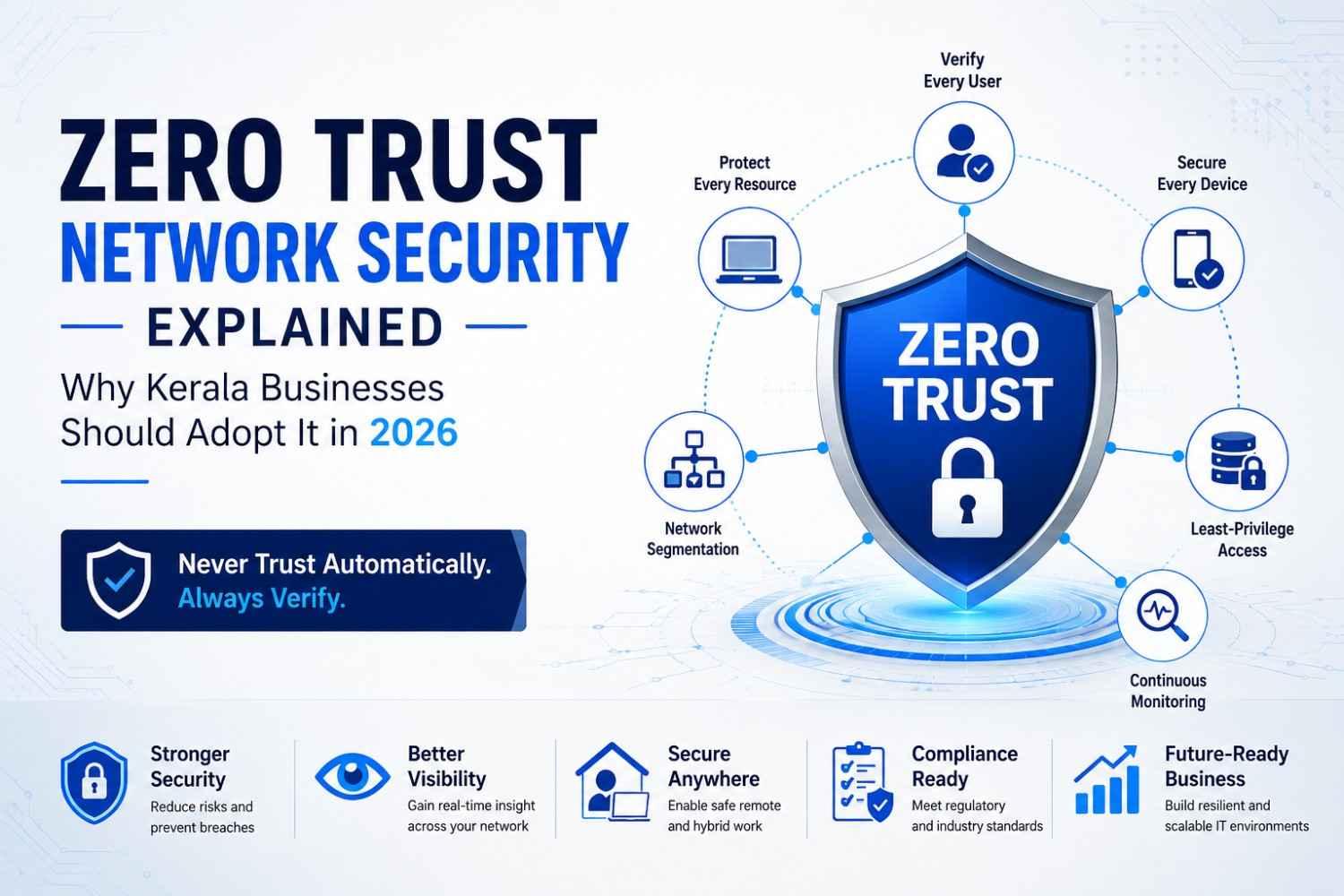
The core principle is simple: never trust automatically and always verify.
What Is Zero Trust Network Security?
Zero Trust Network Security is a cybersecurity framework that continuously verifies users, devices, applications, and connections before granting access to business resources.
Unlike traditional models that often trust users once they enter the corporate network, Zero Trust assumes that threats can exist both inside and outside the network.
Key Zero Trust controls include:
- Multi-Factor Authentication (MFA)
- Identity and access management
- Least-privilege access
- Network segmentation
- Device security validation
- Continuous monitoring
- Threat detection and access controls
Why Should Kerala Businesses Adopt Zero Trust in 2026?
Kerala businesses across healthcare, banking, IT, manufacturing, education, and retail increasingly depend on connected digital infrastructure. At the same time, organizations face risks from stolen credentials, phishing, ransomware, insider threats, compromised devices, and cloud vulnerabilities.
Zero Trust helps reduce these risks by continuously evaluating access instead of assuming that users or devices are automatically safe.
How Does Zero Trust Architecture Work?
1. Identity Verification
Every user must authenticate before accessing business resources. MFA, identity management, password policies, and regular access reviews help prevent unauthorized access using compromised credentials.
2. Least-Privilege Access
Users receive only the permissions required for their roles. Limiting administrative and application access reduces the potential impact of compromised accounts.
3. Continuous Monitoring
Zero Trust continuously evaluates login behavior, device activity, network traffic, and application usage. Unusual activity can trigger additional verification or security responses.
4. Network Segmentation
Dividing infrastructure into security zones limits lateral movement. If an attacker compromises one system, segmentation can help prevent access to sensitive applications and critical business systems.
Why Is Traditional Network Security No Longer Enough?
Traditional security often focuses on defending the network perimeter through firewalls and endpoint protection. Modern businesses, however, operate across cloud platforms, remote networks, personal devices, and third-party applications.
An attacker with stolen credentials or a compromised device may bypass the perimeter entirely. Zero Trust addresses this challenge by applying security controls to users, devices, applications, networks, and data, regardless of location.
How Can IT Network Management Services Support Zero Trust?
Implementing Zero Trust requires continuous monitoring, secure configuration, access management, and regular security assessments. Professional IT Network Management Services in Kerala can support businesses through:
- Network and security monitoring
- Firewall and access-control management
- Network configuration and optimization
- Cloud connectivity management
- Vulnerability assessments
- Security audits and compliance reviews
- Backup and disaster recovery support
Which Businesses Need Zero Trust Security?
Healthcare organizations can use Zero Trust to protect patient records, medical systems, connected devices, and healthcare applications.
Banks and financial institutions need strong controls around customer accounts, online transactions, payment systems, and financial data.
IT and software companies can protect development environments, cloud infrastructure, source code, customer information, and internal systems.
Manufacturing businesses can strengthen protection for IoT devices, production systems, connected infrastructure, and sensitive business data.
Benefits of Zero Trust Architecture
A well-planned Zero Trust strategy can provide:
- Reduced unauthorized access risks
- Stronger protection for sensitive data
- Improved visibility across IT environments
- Better support for remote and hybrid work
- Reduced lateral movement during attacks
- Stronger compliance readiness
- More proactive cybersecurity management
Common Zero Trust Implementation Mistakes
Businesses should avoid treating Zero Trust as simply a technology purchase. Common mistakes include:
- Implementing security tools without a strategy
- Giving users excessive permissions
- Ignoring device security
- Skipping network assessments
- Failing to monitor activity continuously
- Neglecting employee security awareness
How to Implement Zero Trust Successfully
A practical approach begins by identifying critical systems and sensitive data, reviewing existing user permissions, strengthening identity security with MFA, monitoring network activity, and continuously reviewing security controls.
Implementation should be based on the organization's infrastructure, risk profile, compliance requirements, and network maturity.
Why Choose GKS Infotech?
GKS Infotech provides IT infrastructure and cybersecurity solutions for modern businesses, including:
- IT Network Management Services in Kerala
- Network Security Solutions
- Cybersecurity Services
- Cloud Security Solutions
- Managed IT Services
- Data Center Services
- Server Management
- Vulnerability Assessment and Penetration Testing (VAPT)
- Disaster Recovery Solutions
GKS Infotech helps organizations build secure, scalable, and high-performing IT environments using proactive network and cybersecurity practices.
Conclusion
As cyber threats evolve, Kerala businesses need security models that protect beyond the traditional network perimeter. Zero Trust Network Security, supported by professional IT network management and cybersecurity services, helps organizations verify access, protect critical resources, improve visibility, and strengthen resilience.
Businesses can work with GKS Infotech to implement Zero Trust strategies and build a more secure, scalable IT environment.
FAQs
What is Zero Trust Network Security?
Zero Trust is a security approach that continuously verifies users, devices, and connections before granting access to business resources.
Why is Zero Trust important for businesses?
It reduces unauthorized access risks, strengthens data protection, and provides greater security for cloud, remote, and hybrid IT environments.
Is Zero Trust suitable for small businesses in Kerala?
Yes. Zero Trust principles can be scaled according to business size, infrastructure, risk level, and security requirements.
How do IT Network Management Services improve security?
They provide network monitoring, access management, security configuration, maintenance, vulnerability assessments, and ongoing infrastructure management.
How long does Zero Trust implementation take?
Implementation time varies according to infrastructure complexity, existing security controls, compliance requirements, and network maturity.