

SOC vs In-House IT Security: Best Choice for SMEs
As cyber threats continue to grow, businesses in Kerala are becoming more aware of the need for strong, proactive cybersecurity. From ransomware and phishing attacks to data breaches and unauthorized network access, companies today need more than basic antivirus protection or occasional IT support.
One of the biggest questions many businesses face is whether they should choose a Security Operations Center (SOC) or build an in-house IT security team. Both options have advantages, but the right choice depends on business size, budget, risk level, compliance needs, and long-term growth plans.
For many small and medium-sized businesses, managed SOC services offered by trusted cybersecurity companies in Kerala can provide advanced protection without the high cost of maintaining a full internal security team. Many of these providers also offer IT network management services in Kerala to help businesses maintain secure and reliable IT infrastructure.
This guide explains the difference between SOC and in-house IT security teams, their benefits, limitations, and which model is better for businesses in Kerala.
What Is a Security Operations Center?
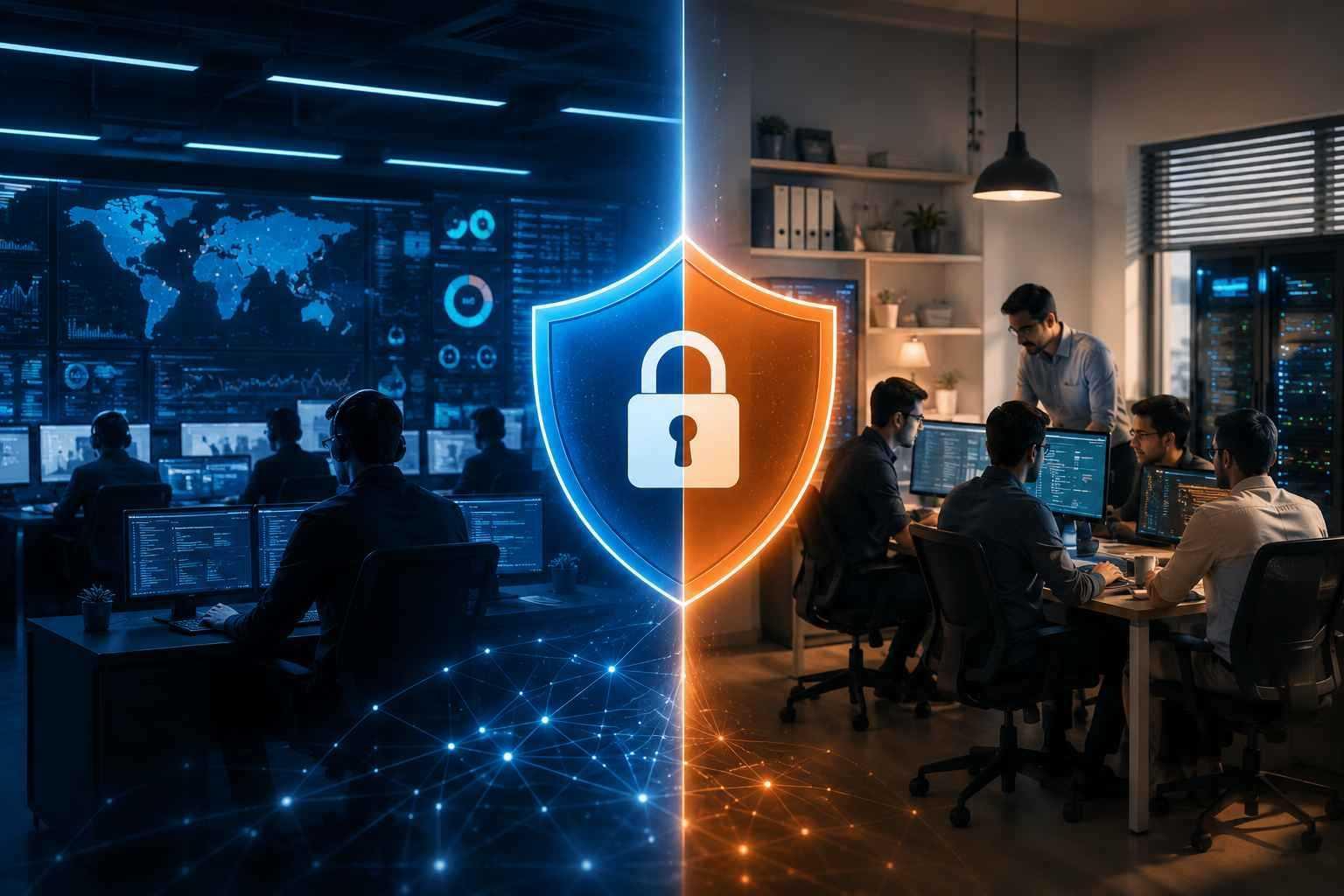
A Security Operations Center, commonly known as a SOC, is a dedicated cybersecurity function that continuously monitors, detects, investigates, and responds to security threats.
A SOC helps businesses protect their digital systems through the following:
-
24/7 network monitoring
-
Threat detection and analysis
-
Incident response
-
Security alert management
-
Vulnerability identification
-
Endpoint and server monitoring
-
Cloud security monitoring
-
Log analysis and reporting
Managed SOC services are usually provided by professional cybersecurity companies in Kerala and other specialized security providers. These services allow businesses to access expert security support, advanced monitoring tools, and real-time threat response without building everything internally.
For businesses in Kerala, especially SMEs, managed SOC services can be a practical and cost-effective way to improve cybersecurity readiness.
What Is an In-House IT Security Team?
An in-house IT security team is a group of employees hired directly by a company to manage its cybersecurity operations. These professionals work within the organization and handle security-related tasks on a daily basis.
An internal IT security team may manage:
-
Network security
-
Firewall configuration
-
Endpoint protection
-
Access control
-
Data protection
-
Security updates
-
Employee cybersecurity support
-
Internal compliance requirements
-
Incident handling
The main advantage of an in-house team is direct control. Since the team works inside the company, they understand internal systems, employees, workflows, applications, and business priorities more closely.
However, building and maintaining a skilled in-house security team can be expensive, especially for small and medium-sized businesses.
SOC vs In-House IT Security Team: Key Differences
|
Factor
|
Managed SOC Services
|
In-House IT Security Team
|
|
Monitoring
|
24/7 security monitoring
|
Depends on team availability
|
|
Cost
|
More cost-effective for SMEs
|
Higher due to salaries, tools and training
|
|
Expertise
|
Access to security analysts and threat experts
|
Limited to internal team skills
|
|
Control
|
Shared with external provider
|
Full internal control
|
|
Scalability
|
Easy to scale as business grows
|
Requires additional hiring and investment
|
|
Technology
|
SOC provider usually offers advanced tools
|
Business must purchase and manage tools
|
|
Best for
|
SMEs, Growing businesses, and companies needing continuous monitoring
|
Large organizations with complex infrastructure
|
|
Response Capability
|
Faster detection through dedicated monitoring
|
Faster internal coordination if team is available
|
|
Compliance Support
|
Available depending on provider expertise
|
Stronger internal control for strict compliance needs
|
Advantages of SOC Services for Businesses
1. 24/7 Threat Monitoring
Cyber attacks can happen at any time. A major benefit of SOC services is continuous monitoring. SOC teams track security alerts, suspicious activities, and abnormal network behavior in real time.
This helps businesses reduce the following:
-
Downtime
-
Data breach risks
-
Unauthorized access
-
Operational disruptions
-
Delayed incident response
For businesses that cannot afford round-the-clock internal monitoring, a managed SOC is a strong solution.
2. Access to Cybersecurity Experts
A managed SOC gives businesses access to experienced cybersecurity professionals, including:
-
Security analysts
-
Threat intelligence specialists
-
Incident response experts
-
Network security professionals
-
Compliance support specialists
Hiring these experts individually can be expensive. SOC services make this expertise more accessible, especially for SMEs in Kerala.
3. Cost-Effective Security for SMEs
Maintaining an in-house cybersecurity team involves several expenses, including:
-
Hiring skilled professionals
-
Security software licensing
-
Monitoring tools
-
Employee training
-
Infrastructure setup
-
24/7 staffing costs
Managed SOC services reduce these costs by offering expert security monitoring as an outsourced service. Many cybersecurity companies in Kerala combine SOC solutions with broader IT support to help businesses strengthen their overall technology infrastructure.
4. Faster Threat Detection
SOC teams use advanced security tools to detect suspicious activity quickly. This includes monitoring logs, endpoints, servers, cloud systems, and network traffic.
Early detection helps businesses take action before a minor issue becomes a major security incident.
5. Scalable Cybersecurity Support
As a business grows, its cybersecurity needs also increase. Managed SOC services can scale more easily than an internal team.
Businesses can expand monitoring, add new systems, improve reporting, and strengthen response processes without hiring multiple new employees.
Benefits of an In-House IT Security Team
1. Better Understanding of Internal Operations
An internal security team understands the company’s systems, workflows, users, and business priorities. This helps them create security policies that match the company’s daily operations.
They can also coordinate closely with departments like finance, HR, operations, and management.
2. Greater Control Over Security Decisions
Some businesses prefer complete control over their cybersecurity strategy. An in-house team allows management to directly control:
-
Security policies
-
Access permissions
-
Data protection rules
-
Compliance workflows
-
Incident handling decisions
-
Internal reporting
This can be useful for large organizations with strict security and compliance requirements.
3. Faster Internal Communication
During security incidents, in-house teams can communicate directly with leadership and employees. This can help speed up internal decision-making and reduce confusion.
However, this advantage depends on whether the internal team has enough resources and expertise to manage threats effectively.
Which Is Better for SMEs in Kerala?
For most SMEs in Kerala, managed SOC services are usually the better option.
Small and medium-sized businesses often need strong cybersecurity but may not have the budget to hire a full internal security team. A managed SOC gives them access to advanced monitoring, expert support, and faster threat detection at a more manageable cost.
SOC services are especially useful for:
-
IT companies
-
Healthcare businesses
-
Educational institutions
-
Retail businesses
-
Financial service providers
-
Manufacturing companies
-
E-commerce businesses
-
Professional service firms
These businesses often handle customer data, payment information, employee records, cloud applications, and internal systems that require continuous protection.
When Is an In-House IT Security Team Better?
An in-house IT security team may be better for large organizations with:
-
Bigger IT budgets
-
Complex infrastructure
-
Strict compliance requirements
-
Multiple branches or departments
-
Sensitive internal data
-
Dedicated technology leadership
-
Advanced internal security policies
Large businesses may prefer in-house teams because they provide direct control and deep internal knowledge. However, even large organizations often use external SOC support to strengthen monitoring and threat intelligence.
Why Hybrid Security Models Are Becoming Popular
Many businesses now use a hybrid cybersecurity model, which combines internal IT staff with external SOC services.
In this model, the internal team manages daily IT operations, while the SOC provider handles continuous monitoring, threat detection, and incident support.
A hybrid model offers:
-
Better security visibility
-
Reduced workload for internal teams
-
Access to expert SOC analysts
-
Improved response capability
-
Stronger network monitoring
-
Better scalability
For growing businesses in Kerala, a hybrid model can provide the right balance between internal control and external expertise.
Why Businesses in Kerala Need Stronger Cybersecurity
Rising Cyber Threats
Businesses are increasingly exposed to cyber risks such as:
-
Phishing attacks
-
Ransomware
-
Data breaches
-
Malware infections
-
Insider threats
-
Weak password attacks
-
Unauthorized network access
Cybersecurity is no longer optional. It is now essential for protecting business continuity, customer trust, and sensitive information.
Increased Cloud Adoption
Many businesses now use cloud-based applications, remote access systems, online payment platforms, and digital communication tools. While these technologies improve efficiency, they also increase security risks.
Professional cybersecurity solutions help businesses secure cloud platforms, endpoints, and user accessProfessional cybersecurity solutions offered by experienced cybersecurity companies in Kerala help businesses secure cloud platforms, endpoints, and user access.
Remote Work and Mobile Access
Remote work has made secure access management more important. Employees may connect from different locations, devices, and networks.
This increases the need for:
-
Multi-factor authentication
-
Endpoint protection
-
Secure VPN access
-
Continuous monitoring
-
User activity tracking
SOC services and IT network management services in Kerala can help businesses manage these risks more effectively.
Best Cybersecurity Practices for Businesses
1. Conduct Regular Security Audits
Regular security audits help identify vulnerabilities before attackers can exploit them. Businesses should review their networks, devices, applications, user access, and security policies frequently.
2. Implement Multi-Factor Authentication
Multi-factor authentication adds an extra layer of protection to business accounts. Even if a password is compromised, MFA can help prevent unauthorized access.
3. Train Employees on Cybersecurity
Employees are often the first line of defense against cyber threats. Regular awareness training can reduce risks from phishing emails, unsafe downloads, weak passwords, and social engineering attacks.
4. Monitor Networks Continuously
Continuous network monitoring helps detect suspicious behavior early. This is especially important for businesses handling customer data, financial information, or cloud-based operations.
5. Partner With Trusted Cybersecurity Experts
Working with experienced cybersecurity companies in Kerala helps businesses access professional monitoring, security planning, and incident response support. These providers often deliver IT network management services in Kerala to improve network visibility, performance, and security.
A trusted provider can also support IT network management, endpoint security, firewall management, and long-term cybersecurity improvement.
Expert Recommendation for Kerala Businesses
For most small and medium-sized businesses, a managed SOC is the more practical choice because it provides continuous monitoring, expert support, and better cost control. It allows businesses to improve cybersecurity without the expense of building a full internal team.
For larger businesses with complex systems and strict compliance needs, an in-house team may be useful. However, the best approach is often a hybrid model that combines internal IT control with external SOC expertise.
This gives businesses better protection, improved visibility, and stronger response capability.
Conclusion
Choosing between a SOC and an in-house IT security team depends on business size, budget, security requirements, and long-term growth plans. For many SMEs in Kerala, managed SOC services offer the best balance of cost, expertise, and continuous protection.
An in-house team may be suitable for larger organizations that need direct control and have the budget to maintain skilled security professionals. However, many businesses can benefit from a hybrid model that combines internal IT knowledge with external SOC expertise.
By working with trusted cybersecurity companies in Kerala and using reliable IT network management services in Kerala, businesses can strengthen their digital infrastructure, reduce cyber risks, and build a secure foundation for future growth.
For businesses looking for professional cybersecurity support, managed IT security, and network protection, GKS Infotech can help create a secure, scalable, and future-ready IT environment.
FAQs
What is a SOC in cybersecurity?
A SOC, or Security Operations Center, is a dedicated cybersecurity team that monitors, detects, and responds to security threats in real time.
Why do SMEs prefer managed SOC services?
SMEs prefer managed SOC services because they provide 24/7 monitoring, expert cybersecurity support, and advanced threat detection at a lower cost than building a full in-house security team.
Are in-house IT security teams expensive?
Yes. In-house security teams require salaries, security tools, infrastructure, software licenses, and continuous training, making them expensive for many small and medium-sized businesses.
Which is better: SOC or in-house IT security team?
For SMEs, SOC services are usually better because they are cost-effective and provide continuous monitoring. For large organizations with bigger budgets and strict compliance needs, an in-house team may be suitable.
Can businesses use both SOC and in-house IT teams?
Yes. Many businesses use a hybrid model where internal IT teams manage daily operations while SOC providers handle continuous monitoring and threat detection.
How do IT network management services improve cybersecurity?
IT network management services help monitor network performance, identify suspicious activity, improve system stability, manage devices, and reduce security risks.
Do Kerala businesses need SOC services?
Yes. Businesses in Kerala that use digital systems, cloud applications, customer databases, online transactions, or remote work setups can benefit from SOC services.